


Myths About Root Canal in Washington, DC & Gaithersburg, MD
A majority of patients dread the idea that root canal therapy is going to be needed. In many cases, we even hear of patients choosing to ignore pain until it reaches a point where they can no longer ignore it. The reality is, most fears around root canal treatment have been exacerbated in our thinking, and there are a lot of myths surrounding it. At District Endodontics, we hope to provide the education and treatment options to put you at ease while improving your oral health.
Root Canal Therapy
Is a Root Canal Really Necessary?
A common question is whether root canal therapy is truly needed. The inner pulp of a tooth can become infected when bacteria make their way in—through decay, a crack or fracture, or a leaking filling or crown. If the pulp becomes infected, root canal therapy is typically the way to save the tooth and protect the teeth around it. The pulp cannot fight the infection on its own. Without treatment, the infection can spread to the surrounding bone and teeth, and the tooth may be lost.

Is Root Canal Treatment Painful?
Most patients are surprised by how comfortable treatment is. The pain people associate with root canals usually comes from the infection itself, not from the treatment. We numb the area with local anesthetic, and if you feel anything, tell us, and we’ll stop and make sure you’re comfortable.
As the infected tissue is removed, the pain improves, and your anesthetic should continue to provide relief for a couple of hours afterward. For patients with significant anxiety, oral conscious sedation may be an option after a review of your medical history.
Can Root Canal Therapy Fail?
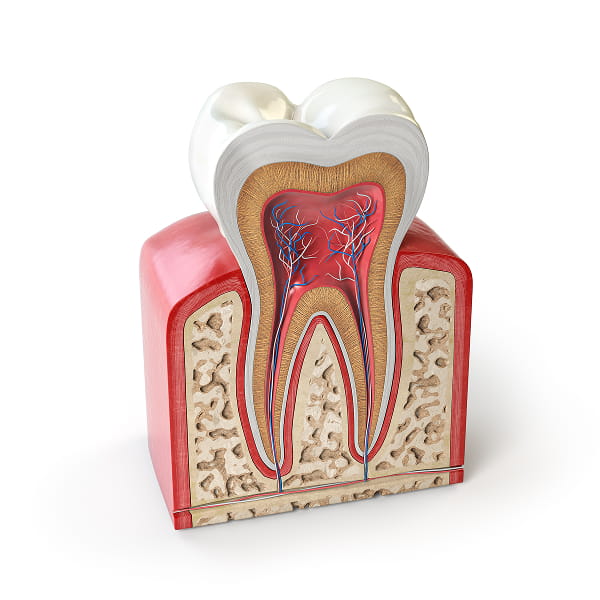
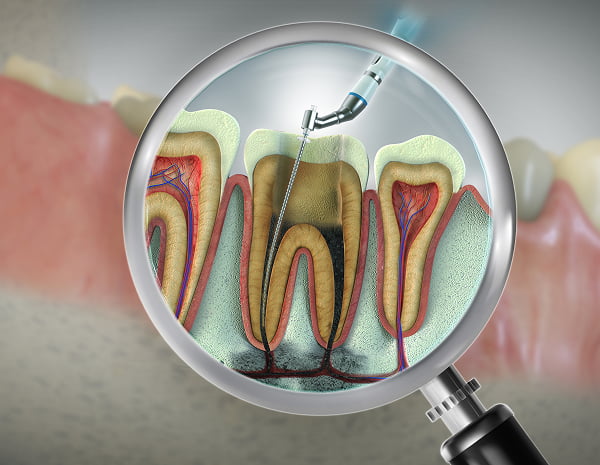
Root canal treatment has a high success rate, but no procedure can guarantee a successful outcome in every case. Inside every tooth, the pulp (the nerve and soft tissue) sits in a chamber and runs down through narrow channels in the roots called canals. Many teeth also have extra canals, curves, and tiny side branches that are hard to see. During a root canal, we remove the infected pulp, clean and disinfect the entire canal system, then fill and seal it so bacteria can’t re-enter.
At District Endodontics, advanced imaging (CBCT), high-powered magnification, and precise techniques help us identify complex anatomy and treat the tooth as thoroughly as possible. If a tooth doesn’t heal as expected, additional treatment may sometimes be possible. An evaluation can help determine the cause of the problem and whether retreatment or another approach may help preserve the tooth.


Is a Dental Crown Necessary Following Root Canal Therapy?
Often, but not always. Root canal therapy removes the infected pulp from inside the tooth, and the tooth stays in place and continues to function. Many teeth that need a root canal have already lost structure to decay, cracks, or large fillings, so a permanent restoration is recommended to restore their strength and function under everyday biting forces.
Back teeth that handle heavy chewing usually benefit from a crown, and some front teeth may need one too. Your general dentist will determine whether a filling or a crown is right for your tooth.