

Dental Trauma in Washington, DC
Restoring tooth health after traumatic injuries at District Endodontics.
Crown and Root Fractures
While dental trauma is more common in children and teenagers, accidents can happen to anyone! At District Endodontics, Dr. Zand specializes in evaluating and treating traumatic dental injuries with the precision and urgency they demand.
A crack or fracture to the crown (the visible portion of the tooth) may or may not be a dental emergency, depending on its severity and location. If the fracture is limited to the outer enamel and causes no pain, it can often be monitored. But when the crack reaches the dentin or pulp, bacteria have a direct pathway to the nerve—and that needs to be addressed promptly.
If the crack remains untreated for a significant amount of time, an infection in the pulp is all but guaranteed. If infection does occur, we typically perform a root canal to stop it from spreading to other areas.
Even more, a root fracture—whether vertical or horizontal—is a more serious situation. Depending on the location and extent of the fracture, Dr. Zand will evaluate every option before recommending a path forward, which may include stabilization with a splint or, in some cases, extraction and replacement.


Alveolar Fracture
Your teeth are situated in a bony part of the jaw known as the alveolar ridge. Injury or trauma to the alveolar ridge can threaten the life of a tooth and affect your facial appearance. A fracture or break near the root of a tooth may require care from a specialized endodontist.
Typically, an oral surgeon treats alveolar fractures by repositioning displaced segments using a splint, scaffold, or mesh to stabilize the area. And in some cases, regenerative endodontics may also be recommended—an approach that uses bioactive materials to support tissue healing with greater precision and effectiveness. Every recommendation is based on a thorough evaluation of your specific case.
Avulsed or Knocked-Out Tooth
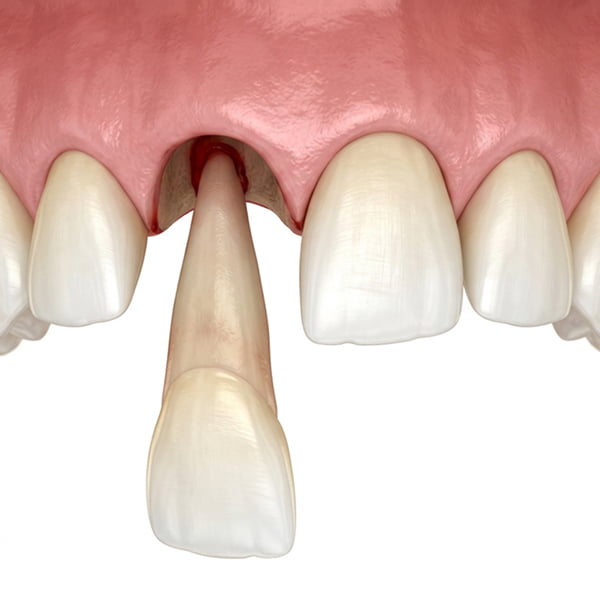
A dislodged or avulsed tooth occurs when a blow to the face pushes the tooth into or out of its socket. This is considered one of the more serious injuries. Ultimately, the goal is to place the tooth back in its correct position and avoid the need for an extraction.
Once stabilized, Dr. Zand will assess whether the pulp has been affected and recommend next steps, which may include a root canal or regenerative endodontics. If the pulp is intact and undamaged, stabilization alone may be all that’s needed.
A completely knocked-out tooth is a dental emergency, and every minute counts. The faster the tooth is reinserted, the greater the chance it will reattach to the bone. In some cases, 30 minutes can make the difference between saving and losing the tooth.
If your tooth gets knocked out:
- Call us immediately so we can get you seen as fast as possible
- Handle the tooth by the crown only—never the root
- Rinse it gently with room-temperature water—do not remove any soft tissue still attached
- Try to reinsert it into the socket right away if you can
- If reinsertion isn’t possible, keep it moist—between your cheek and gum, or in a glass of milk
Once you’re with us, Dr. Zand will stabilize the tooth with a splint and determine the best path forward from there.